
Anti-Crash Course
By Aaron Wulff
Recently this Newsweek headline appeared in my feed: Bride and Groom Tumble Over During Wedding First Dance: ‘Falling in Love’.
This is an amusing video, but probably because it’s not one of us. Does anybody want to end up in the national news for taking a nosedive at their wedding?
Hard pass.
Fame and publicity aside, most falls I’ve seen end up with nothing more than bruised egos and sore buttcheeks. But I’ve also seen scary injuries like concussions and dislocations. You shouldn’t be scared to dance, so here’s how you can stay upright and stay off the social media fail playlists.
Stop yanking
I can always tell who’s going to end up on their ass at a wedding. I see them approach the dance floor while I’m eating my cake. You can spot them from a mile away because:
- They’re the first ones on the dance floor
- One of them is way too excited or drunk.
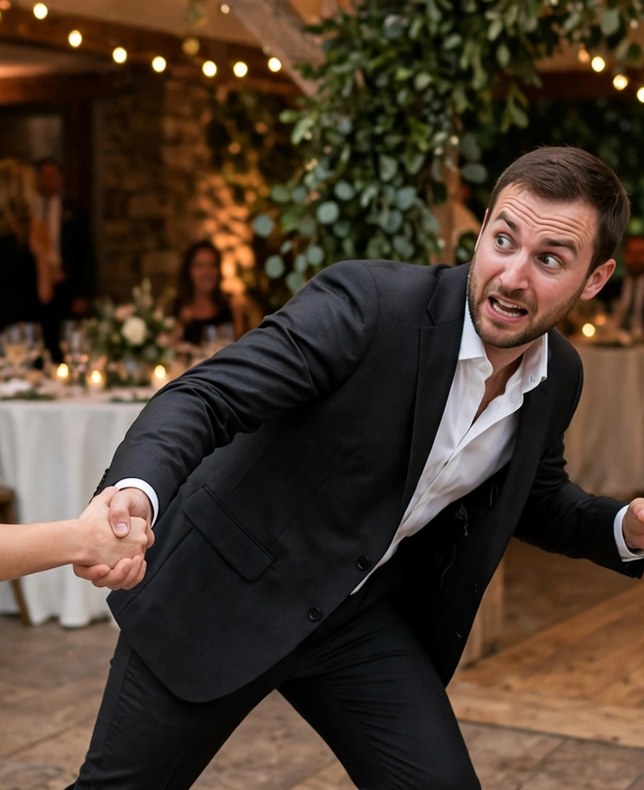
- They start yanking, jerking, and pulling
They laugh. They spin. Her heels are slippery, his hands are sweaty. They’re having a great time. After a few reckless moves, their confidence grows. He pulls hard. She whips across the dance floor. They’re in the zone now, nothing can stop them. Can I get some more cake before this next part?
She lunges back in a big way. He’s not ready for it. He loses his grip and she goes flying. Wedding guest(s) down! Hopefully everyone’s ok. But come on, we saw it coming. And so should you.
The name of the game in this situation is always balance. Or lack thereof. If I pull on you hard enough I’m going to change your balance, and maybe mine too. If I’m not balanced then I need you for balance. But what if you’re not balanced either? What if my hands slip or our shoes aren’t gripping the floor? Get the point? Any and all of these lead to crashing.
Even better? If I’m clinging to you when I fall, you’re coming down with me.
This is why I teach my couples two rules:
- Never to yank on each other.
- You’re in charge of your own balance.
Number one is obvious. But what about number two? What does “being in charge of your own balance” even mean? It means this: unless we’ve agreed upon a special move ahead of time (like a dip) it’s your job to keep your feet underneath your body. A dip is a learned skill: learn it in person, practice it together, or skip it. The posed finish needs no dip. You can’t rely on your partner to hold you up at any time. Following these two rules is easily the most effective way to avoid a fall.
Get low
So if you’re in charge of your balance, how do you get better at balancing?
Balance is all about your COG (Center of Gravity). The lower your center of gravity, the more stability you have.
If you play sports you’re familiar with the body position you need to be in to “make a play.” Your knees are slightly bent and your center of gravity is lowered. This helps you stay balanced and ready to move. Using an athletic stance can help you in dance too. If you feel like a wobbly giraffe when you dance, try lowering into your knees and squeezing your butt (your glutes) to give you some support. This is especially helpful for spins, turns, and dips.
Doing this shouldn’t be noticeable to anyone except you. You’re not getting ready to wrestle each other. Instead, you’re activating the muscle groups (like your core and legs) that help you stay supported in the lower part of your body just enough to give you extra balance. Like a swan, you can work hard below the surface, and stay graceful on the top.
Mind the train
Will your dress have a train? Trains look great in photos but they’ll make dancing tough. Dancing with a train can limit the kind of steps you can take, and one wrong move could land you on your ass or a YouTube fail playlist.
One foolproof option is to switch dresses for your reception. If that’s out of the question you can try holding your train or fastening it with pins, velcro, or magnets before your dance. No matter what you choose, make sure you check your range and mobility at your fitting and practice dancing in your dress so you know what you’ll be capable of doing.
Keep it small
Ask a kid to draw a person and they’ll draw enormous hands on a small body. Ask a groom to do a simple box step and he’ll take huge steps like the floor is made of lava.
When we’re working on our motor skills, whether it’s dancing, swimming, or bowling, we usually start with big movements so our brain can “see” what we’re trying to learn. As we practice repetition we become more coordinated making the motion smaller and more efficient.
Big steps in dancing give you too much momentum and you can lose your balance. Watch videos of dancing brides and grooms who land on their asses. You’ll usually see one of them take a bigger step than they should have right before they fall.
If you or your partner are taking steps that are bigger than the width of your shoulders then it’s time to dial it back. Big steps make it hard for you to stay balanced and hard for your partner to keep up. Smaller steps will help you both stay in control.
Minimize risk, maximize fun
A great dancer once told me, “any time you step on the dance floor you’re taking a risk. But so what? Are you just going to sit and watch?”
This philosophy applies to life too. Getting out of bed is a risk. Combine excitement, drinking, and slippery shoes and eventually someone will end up on their ass. But following better techniques will help ensure you stay on your feet and have a great time on the dance floor.